
Blog · · Updated · By Matt Senter
Why Rain on Your Desktop Can Feel Calming
Ask a room of people where they do their best thinking and someone will say “on a rainy afternoon.” It is not only nostalgia. Rain is a kind of background stimulation a lot of people find settling, and there is real research on natural sounds and restorative environments that hints at why. Here is what that research says, what it does not say, and why a little rain on your desktop might help.
Rain is noise without information
Your attention is tuned to detect change: a voice starting, a notification, a door. Steady rain has enormous detail but almost no events. Each drop is a tiny, random impact, and thousands of them blend into a broadband hush. That hush gets compared to pink noise: in UW Medicine’s explanation, featuring audiologist Iris Langman, pink noise puts less emphasis on high frequencies than white noise does, which gives it a gentler sound people liken to steady rainfall. (Formally, pink noise carries roughly equal power in each octave, its power spectral density falling as frequency rises.) That is a description of how the sound is shaped, not a demonstration that it is the background noise most people find easiest to ignore. Still, the brain files a sound with no events in it as “nothing new here” and stops spending effort on it, which leaves more effort for the thing in front of you.
The useful distinction is not loud versus quiet, it is predictable versus informative. A café at sixty decibels can be harder to work in than rain at the same level, because the café keeps producing fragments of speech, and speech is the one signal your auditory system refuses to file away. Rain never resolves into anything. There is nothing in it to catch, so after a minute or two there is nothing in it to check.
That is the same reason white-noise machines and “rain sounds for sleep” playlists are everywhere. Rain masks the unpredictable sounds that would otherwise pull you out of a task, and it does so without adding anything you need to interpret.
The research here is broader than rain, and worth reading as such. In a 2021 review and meta-analysis, Rachel Buxton and colleagues screened 36 publications and pooled 18 of them, and found aggregate evidence that listening to natural sounds reduces stress and annoyance and improves health and positive emotional outcomes. A smaller 2010 experiment by Jesper Alvarsson and colleagues found that skin conductance recovered from a stressor faster while participants listened to a recording of a fountain and birds than while they listened to loud traffic noise, though the effect did not hold against the quieter noise conditions and heart-rate variability showed nothing. Both concern natural soundscapes in general. Neither is a study of rain, and neither says anything about an animated rainy desktop.
Why visuals matter as much as sound
Almost everything written about rain and focus is about audio. Search for it and you get playlists, sleep apps, and noise machines. That is a strange gap, because the thing people actually describe when they talk about a good rainy afternoon is usually something they saw: the window, the gray light, the water running down the glass. The visual half of rain does real work, and it does it through a different mechanism than the sound.
Soft fascination, and why motion without events is restful
The useful frame here is Attention Restoration Theory, developed by Rachel and Stephen Kaplan. Their argument is that directed attention, the effortful kind you use to stay on a task and ignore everything else, is a limited resource that depletes and needs to recover. What restores it is not an empty room. In the 1995 paper where Stephen Kaplan sets out the framework, it is an environment offering soft fascination: stimulation that holds the eye effortlessly, without demanding a decision, leaving room for reflection while effortful attention rests. Kaplan is careful on the point that fascination by itself does not guarantee restoration, and the paper is a theoretical framework, not a study of anything on a screen.
The classic examples are all things people stare at without meaning to. A fireplace. A fish tank. Leaves moving in wind. Waves. What they share is continuous motion with no discrete events in it, nothing that starts or stops, nothing that requires a response. Hard fascination, by contrast, is a car chase or a feed: it grabs attention completely and leaves nothing spare, which is engaging but not restorative.
Rain sits firmly on the soft side, and water on a surface sits further onto it than falling rain does. A drop running down glass is slow, has an unpredictable path, and resolves into nothing in particular. Your eye can follow it or not. Neither choice costs anything, and neither produces information you then have to act on.
There is a little experimental work on brief visual encounters with nature, too. In a 2015 experiment by Kate Lee and colleagues, 150 students took a 40-second micro-break partway through an attention task: those who spent it looking at a flowering green roof made fewer omission errors and responded more consistently afterwards than those who looked at a bare concrete roof. That tested a short deliberate break rather than continuous motion in the background, so treat it as context for the idea rather than evidence that a rainy desktop does the same thing.
The variable that decides it: events, not pixels
Ambient motion tips from restful to irritating faster than most people expect, and the thing that flips it is almost never the amount of movement. It is whether the movement contains events. Your visual periphery is essentially an event detector. It is poor at detail and excellent at noticing that something appeared, vanished, or changed direction sharply. A screensaver that fades between photographs is far more distracting than a much busier fish tank, because every fade is an event and no fish is.
The practical rules that follow are narrow. Motion has to be continuous rather than cyclical, so there is no moment that repeats and invites you to anticipate the next one. Contrast has to stay low, because a high-contrast edge crossing the periphery reads as a thing rather than as texture. Nothing can flash or pop. And crucially, the motion has to stay out of the small region where you are actually reading. Ambient weather is a peripheral medium; the moment it moves across the words, it stops being ambient and becomes a thing you are reading past.
Why rain on your own windows is not the same as a video of rain
You can already put a looping video of a rainy window on a second monitor, and some people do. It works, up to a point, and the point where it stops working is instructive.
A video is a rectangle of somewhere else. Your visual system resolves it as a picture: flat, bounded, at a fixed depth, with a frame around it announcing that it is a representation. The first time through, that is lovely. By the third loop it is a cycle, and cycles have events, which is exactly the property soft fascination requires the absence of.
Rain composited into the desktop you are already using behaves differently, for one specific reason: occlusion. When a drop falls behind the window you are typing in and reappears on the other side of it, the scene has depth, and depth is what makes the brain treat something as space rather than as a picture. It is the same cue that makes a diorama read as a room. Weather that sits in front of everything is a sticker on the glass. Weather that respects what is in front of what is a small amount of space you happen to be working inside of.
This is the part that turned out to be most of the engineering work. Reading the front-to-back order of the windows on a display, tracking it as they move, and discarding every particle and every rivulet that falls behind a nearer surface is considerably harder than drawing rain on top of a screen. It is also the entire difference between the two experiences.
What the research does not say
Worth being straight about the limits. Every source above studies something adjacent to this app rather than this app: natural sounds in general, a fountain and birdsong, a green roof seen for forty seconds, a theory of restorative environments. None of them tested Weatherling, rain specifically, or a continuously animated desktop, and nothing here should be read as evidence that one works. Attention Restoration Theory is a well-supported framework, but most of the evidence behind it comes from real natural environments, walks in parks and views of trees, not from simulations of them on a display. The studies on simulated nature are smaller and more mixed, and a desktop effect is a long way from a forest.
Individual variation is also large and under-discussed. A meaningful fraction of people find any ambient motion in their peripheral vision unpleasant, and that has nothing to do with willpower or preference; it is how their attention is wired. Some people with ADHD report that background stimulation helps a great deal, and others report the opposite just as strongly. Nobody should talk themselves into finding something restful.
So the honest claim is narrow. For people who already like rain, a calm, event-free, depth-correct version of it in the space they work in is a cheap way to get some of what a rainy afternoon gives them. That is a smaller claim than most of what gets written about focus tools, and it is the one the mechanism actually supports.
Bringing the rain indoors
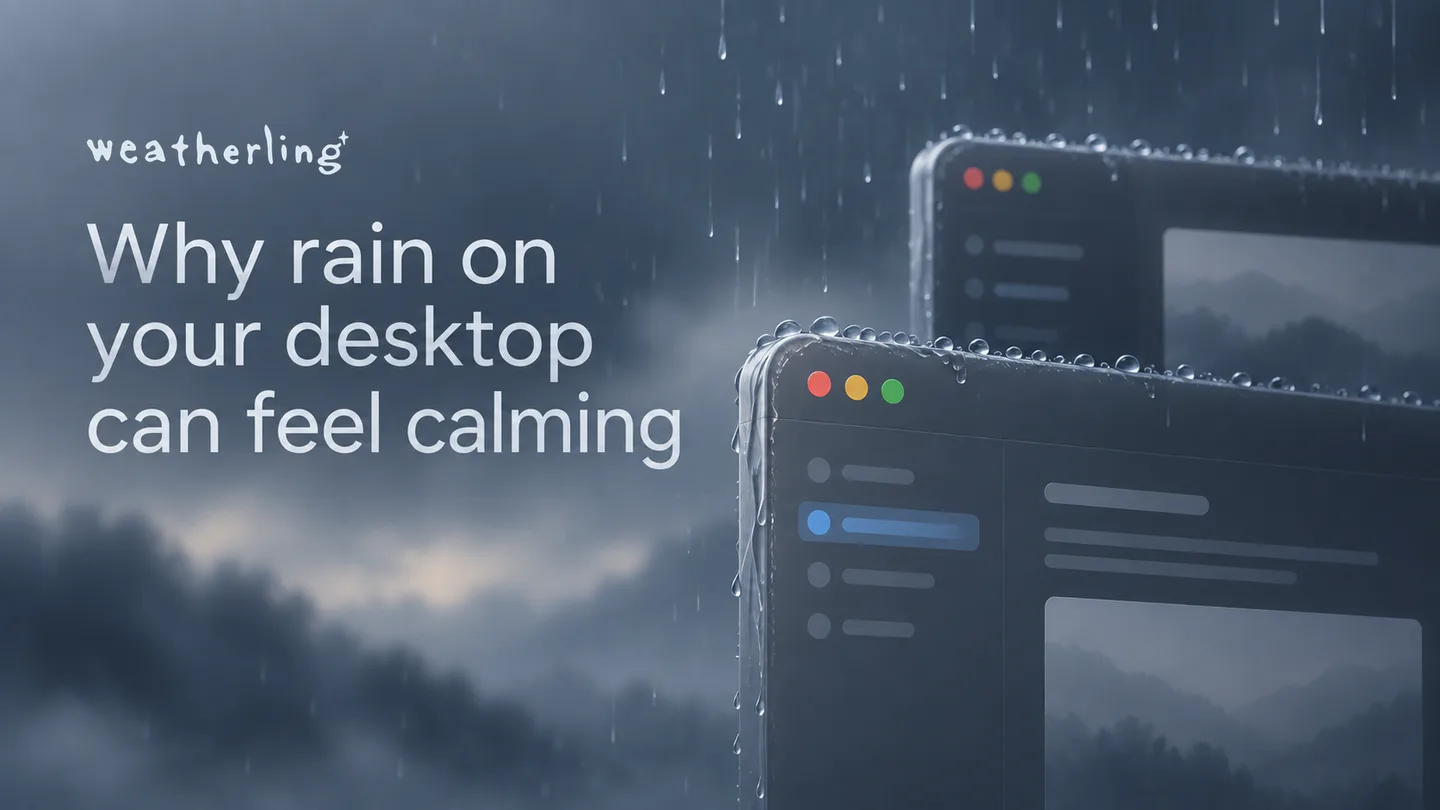
This is the whole idea behind Weatherling. It is a small menu bar app for macOS that makes rain fall among the windows you already have open. Drops land on the top edges of your real windows, gather in the corners, and run down the sides. Turn up the intensity and the edges overflow into little waterfalls. Turn it down and it is a drizzle you barely notice.
Most of the design decisions come straight out of the section above. The depth ordering exists because occlusion is what separates space from wallpaper. The lowest intensity setting is genuinely faint, because the target is just below awareness and a floor that is still too heavy makes the whole thing useless. There is no thunder and no lightning flash, because a flash is an event and one event undoes an hour of texture. And the sound starts off: there is a looping recording of a real downpour, with its own volume, but it waits until you turn it on, because forcing a particular soundtrack on someone who has their own is a worse default than silence.
A few more choices keep it from becoming a distraction of its own. The overlay is click-through, so it never steals a click or takes focus. It respects the real front-to-back order of your windows, so it reads as weather in the room rather than a sticker on the glass. And it is one click away from off, in the menu bar, which matters more than it sounds: ambient effects are only relaxing when you are fully in control of them.
Weatherling runs sandboxed and never asks for Screen Recording, Accessibility, or any other special permission. It only reads the window positions macOS shares with every app, never their contents. How it does that without Screen Recording has the details, and the Privacy Policy says exactly what is and is not stored.
A small recipe for a rainy work session
- Pick one task and a window for it. Rain works best with a single thing to return to.
- Start with drizzle. If you notice the rain, it is too heavy. You want it just below awareness.
- Turn on the rain sound at low volume, or leave it off. Silence plus visual rain is underrated.
- Decide, on purpose, that the world is closed for an hour. Silence notifications and let the errands wait.
- When you are done, turn the rain off. Ending the weather is part of ending the session.
Rain will not do the work for you. But it is one of the cheapest, gentlest ways to make a stretch of focused time feel like something you chose instead of something you have to endure. Stay in. Let it rain.