
Blog · · By Matt Senter
Weatherling's Story So Far: From a Rain Experiment to the Mac App Store Top 10
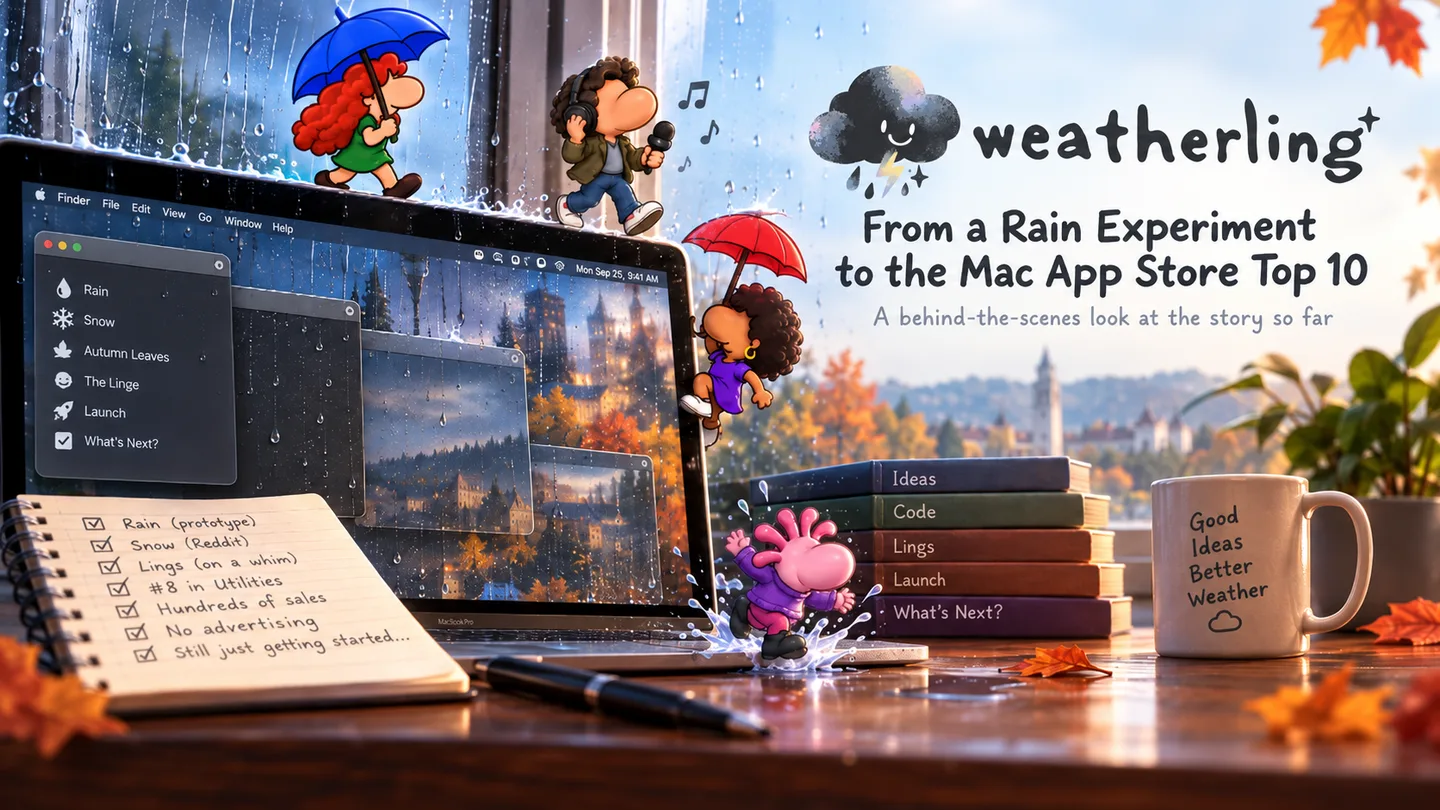
Two weeks ago, Weatherling was a little Mac app that made rain fall on desktop windows. Since then, it's climbed to #8 in Mac App Store Utilities, sold hundreds of copies without advertising, and grown into a world of snow, autumn leaves, and collectible characters called Lings™. Here's how it happened.
It started with a little rain
I spend a lot of time at my Mac, and I've always liked the idea of making the desktop feel a little more atmospheric. One day, I thought it would be nice to have some rain falling on my windows while I worked. Nothing elaborate, just a little ambient weather to make the desktop feel more alive.
I was also curious about Metal, Apple's graphics framework. I'd been developing software for years, but I'd never worked with Metal before. This seemed like a fun excuse to learn something new.
I knew Swift, and with help from Codex and Claude Code, I began piecing together a prototype. The goal was to render rain that actually interacted with desktop windows rather than simply playing an animation over the screen. The first version was incredibly simple. No snow, no wind, no leaves, no characters, and definitely no game. Literally just rain.
But it worked! Raindrops fell across the desktop, interacted with window edges, and created the illusion that the weather was happening around my applications. I thought it was pretty neat, so I posted a video on Reddit to see what other people thought.
Reddit had some ideas
The response on Reddit was much more enthusiastic than I expected. The posts attracted lots of upvotes, encouraging comments, questions, and suggestions. People seemed to enjoy the idea of weather interacting with their desktop windows, and almost immediately, they started asking for more.
One of the first requests was snow, so I added snow. People also wanted more control over the weather, so I kept refining the effects and adding options for intensity, depth, and wind direction. Later, people asked for falling autumn leaves. That sounded like a perfect seasonal addition, so those eventually made their way into version 1.4.
Looking back, it's funny how much of Weatherling's evolution has come directly from Reddit comments. Snow and autumn leaves weren't in my original plan. They happened because people saw the prototype, liked the idea, and imagined what else it could do.
One thing became clear pretty quickly: people weren't necessarily looking for another productivity tool. They liked the idea of making their Mac a little more fun. That realization opened the door to something I hadn't anticipated at all.
Enter the Lings™
At some point during development, I decided Weatherling needed a little personality. The weather effects were fun on their own, but I wondered what would happen if tiny characters occasionally appeared on the desktop, wandering around the edges of windows and reacting to the weather.
So, on a whim, I created the first Lings. These little characters could walk, run, jump, splash in puddles, and open umbrellas when it rained. They weren't meant to serve any practical purpose. They were just something fun to discover while working.
But once I had characters wandering around the desktop, I started wondering whether I could turn them into a little game. That's how the Ling collection game was born.
Every so often, colored boxes appear on your windows. The objective is to collect Lings in those boxes and earn points. The interesting part is that neither the Lings nor the boxes are equally common. Some Lings are much rarer than others, and the same goes for the boxes.
I came up with a scoring algorithm that considers the relative rarity of both. A common Ling in a common box won't score very much, but putting a particularly rare Ling into an especially rare box can earn a substantial number of points. There are even hidden bonuses for certain combinations.
The basic idea is simple: Put the rarest Lings in the rarest boxes for the highest score. Share and compete with friends.
I also intentionally built sharing into the experience. I wanted people to be able to show off their Ling Scores and challenge their friends, giving Weatherling a way to spread organically beyond the people who initially discovered it.
It's a completely optional minigame. If all you want is a little rain on your desktop, that's exactly what you can have. But if you enjoy collecting things and chasing high scores, there's another layer to explore. And the Lings themselves have become one of my favorite parts of the entire project.
Making Lings with my kids
As the collection grew, my kids got involved. We started sitting together, coming up with characters and figuring out what they should look like and how they should move. Using AI-assisted development tools, we'd create spritesheets, experiment with animations, and then bring the characters into Weatherling. It became a really fun collaborative process.
Some characters are fairly straightforward. They walk, run, jump, and carry umbrellas. Others have much more elaborate personalities and special animations. Some transform into other creatures, some arrive in unusual ways or make dramatic exits, and others have their own props, vehicles, or distinctive movements.
The possibilities are pretty much endless, and brainstorming increasingly ridiculous Ling ideas with my kids has been a blast. What started as a technical experiment to learn Metal has turned into something of a family creative project. I never expected that when I rendered those first raindrops.
Launching Weatherling
On September 25, 2026, I released Weatherling on the Mac App Store. I didn't have a big marketing campaign prepared. There was no advertising budget, no paid promotion, and no elaborate launch strategy. I posted about it on Reddit, shared it through my own channels, and hoped people would find it interesting.
A couple of days after launch, a friend messaged me to point out that Weatherling was climbing the Mac App Store charts. I hadn't even been paying attention to the rankings. When I checked, Weatherling had reached #15 in Mac App Store Utilities, which was a pretty exciting surprise.
But it kept climbing. Within the first week, Weatherling reached #8 in Utilities, putting my little rain experiment among the top ten apps in its category.
And the ranking wasn't the only surprise. In its first two weeks, Weatherling sold hundreds of copies without a single dollar spent on advertising.
Every sale came from organic discovery, Reddit posts, word of mouth, and people sharing the app with others. For a solo indie developer, that's incredibly encouraging. It's one thing for someone to upvote a video of a cool effect on Reddit. It's another for them to actually spend their own money on something you've built.
The sales were gratifying, but so was the continuing feedback. People were reporting bugs, requesting features, sharing their experiences, and helping shape the next versions of the app. Several of Weatherling's features exist today specifically because someone took a moment to leave a comment.
It's been a great reminder of what I love about indie development. Sometimes you don't need a giant team or a huge marketing budget. You can build something you personally wish existed, put it out into the world, and see whether other people enjoy it too.
Private by design
One thing I haven't talked about much is how Weatherling works behind the scenes, particularly when it comes to privacy. From the beginning, I wanted Weatherling to be completely self-contained.
Weatherling intentionally has no networking functionality. There's no account to create, no cloud service to connect to, no analytics collecting usage data, and no server quietly receiving information about your computer.
Everything the app needs ships with it. All the Lings, their spritesheets and animations, the weather effects, and the other assets are bundled into the application. Nothing needs to be downloaded dynamically while you're using it.
The weather system itself works by examining the geometry of desktop windows, not their contents. That means Weatherling doesn't need Screen Recording permission. It doesn't capture your screen, read what's inside your windows, or watch what you're doing.
Even the Ling collection game runs locally. Your score stays on your Mac unless you explicitly choose to share it using the sharing functionality.
I think there's something refreshing about software that doesn't need to phone home. Weatherling doesn't need to know who you are, what you're working on, or how you use your computer. It just needs to know where your windows are so it can make rain fall on them.
Two weeks later: Weatherling 1.4
As I write this, Weatherling 1.4 has just been released. The latest update brings falling autumn leaves, another feature inspired by Reddit feedback, along with additional Lings and continued improvements throughout the app.
It's remarkable how much the project has changed in such a short time. Two weeks ago, I was launching a Mac app that made rain fall on windows. Today, Weatherling supports rain, snow, wind, and autumn leaves. There are characters wandering around the desktop, each with their own personalities and animations. There's an optional collection game with rarity-based scoring, hidden bonuses, and shareable scores.
And underneath it all, there's still that same little Metal rendering experiment that started everything.
One of the things I've enjoyed most is learning along the way. Working with Metal has been a fascinating experience, and using Codex and Claude Code as development partners has helped me explore ideas and implement features much faster than I otherwise would have. It's also made it possible to spend more time on the creative side of development, including all those increasingly elaborate Lings my kids keep dreaming up.
Weatherling is still a small app, but it's become much more than I originally imagined.
Next stop: Product Hunt
Today marks another milestone: Weatherling is launching on Product Hunt. This is my first solo Product Hunt launch, and I haven't participated in a Product Hunt launch of any kind in years.
I'm curious to see how the community responds, particularly now that Weatherling has evolved beyond the original rain prototype. I'm also interested in what people will suggest next.
If the past two weeks have taught me anything, it's that releasing software is often just the beginning of figuring out what it should become. Snow came from Reddit. Autumn leaves came from Reddit. The Lings started as a random idea and turned into a game. My kids helped turn that game into a growing collection of unusual little characters.
And somehow, in the middle of all that, Weatherling reached the Mac App Store top ten and sold hundreds of copies without advertising. Not bad for something that started because I wanted to see a little rain on my Mac.
Thanks to everyone who has downloaded Weatherling, shared a post, left a comment, reported a bug, or suggested something new. Your enthusiasm has made these first two weeks far more exciting than I ever expected, and I'm looking forward to seeing where this goes.
I have a feeling we're just getting started.
- Try Weatherling: Download on the Mac App Store
- Support our Product Hunt launch: Weatherling on Product Hunt
- See it in action: Watch the Weatherling demo